What Tools or Templates Help Reduce Report Time for Mystery Shopping
What tools or templates help reduce report time for mystery shopping is mostly about removing friction—not “writing faster.”
Most mystery shoppers don’t lose time during the visit. They lose it afterward: hunting for details, reconstructing timelines, re-reading instructions, uploading scattered photos, and fixing avoidable revisions. The solution is a small set of repeatable tools and templates you use the same way every time.
Below are practical, no-fancy-tech options you can set up in an hour and use for months.
If you’re still getting oriented, start with the Mystery Shopping for Beginners for the bigger picture.
The “report time” problem in one sentence

Report time expands when you have to think about what to capture while you’re capturing it.
A good template makes the visit feel simpler because it tells you, in advance, exactly what you’ll need to write later.
What Tools or Templates Help Reduce Report Time for Mystery Shopping: the 6-template system
You don’t need dozens of documents. You need six that cover the full workflow:
- Pre-shop instruction checklist (1-page)
- Timing + interaction log (one note)
- Observation bullets (store/space/service)
- Receipt + photo workflow (naming + foldering)
- Narrative builder (two-paragraph framework)
- Pre-submit QC checklist (60 seconds)
If you implement nothing else, implement these.
1) Pre-shop Instruction Checklist (the “don’t-miss” page)
Before you go, convert long instructions into a short checklist you can glance at.
Copy/paste this and fill it in per assignment:
```text
ASSIGNMENT SNAPSHOT
- Location / Store ID:
- Shop window:
- Report due (time zone):
- Required purchase (if any):
- Reimbursement cap + rules:
- Must-do actions (3–7 bullets):
- 1)
- 2)
- 3)
- Must-observe items (3–7 bullets):
- 1)
- 2)
- 3)
- Required proof (uploads):
- Receipt photo? Y/N
- Photos needed (list):
- Any screenshots? Y/N ```
This single page is one of the strongest answers to what tools or templates help reduce report time for mystery shopping, because it prevents the most expensive mistake: missing a required step and triggering a revision or rejection.
2) Timing + Interaction Log (your “facts over feelings” note)
Most reports boil down to facts: times, sequence, and key behaviors. Use a standard timing note every time:
```text
TIMING LOG
- Arrived:
- First acknowledgment:
- Order/request made:
- Service delivered:
- Receipt offered? Y/N
- Left: STAFF
- Name (if visible):
- Description (neutral): KEY REQUIRED MOMENTS
- Suggestive sell? Y/N + what:
- Mentioned policy/feature? Y/N + what: ```
The big win: you’re not “remembering”—you’re recording. That’s how you keep what tools or templates help reduce report time for mystery shopping from turning into “What do I think happened?”
3) Observation Bullets Template (so you don’t ramble)
Many shoppers waste time writing long paragraphs that the form doesn’t reward. Use short bullets tied to common categories:
```text
OBSERVATIONS
- Cleanliness:
- Queue/wait:
- Staff professionalism:
- Accuracy/completeness:
- Environment (noise, lighting, signage):
- Anything unusual (facts only): ```
When the report asks an open-ended question, you can convert one bullet into one sentence—fast.
4) Receipt + Photo Workflow (the hidden time saver)
Uploads and receipt handling create more delays than most people realize. Use two rules:
Rule A: One folder per shop day (or per client).
Example structure:
- MysteryShops / 2026-07-22 / ClientName / Location
Rule B: Consistent file naming.
Use a pattern like:
- client_location_date_receipt.jpg
- client_location_date_storefront.jpg
This matters because searching for “IMG_4937” is not a business process. A clean workflow is a direct answer to what tools or templates help reduce report time for mystery shopping because it reduces upload mistakes and prevents last-minute scrambling.
5) The Two-Paragraph Narrative Builder (fast, clear, and QC-friendly)
When you do need a narrative, don’t reinvent the wheel. Use this:
```text
PARAGRAPH 1: Sequence + timing (facts)
"I arrived at .
I was acknowledged at _.
I placed my order/request at and received at _."
PARAGRAPH 2: Required behaviors + key observations (facts)
"The employee [did/did not] .
They [did/did not] offer .
The area appeared with [one specific detail]."
This keeps your writing short, neutral, and consistent—exactly what QC tends to reward.
6) 60-Second Pre-Submit QC Checklist (revision prevention)
Revisions are the silent killer of “low report time.” Before you click submit:
```text
PRE-SUBMIT QC (60 seconds)
- Correct location selected? Y/N
- Shop date/time fields correct? Y/N
- All required questions answered (no blanks)? Y/N
- Receipt uploaded (if required)? Y/N
- Required photos uploaded (if required)? Y/N
- Narrative matches facts (no guessing)? Y/N
- Reimbursement rules followed? Y/N ```
If you only adopt one habit from this article, adopt this one.
“Tools” that help (without complicating your life)
You can run all of this with basic, common tools:
- A notes app (for templates and checklists)
- A calendar/reminder system (shop window + report deadline buffer)
- A simple document or spreadsheet (for tracking time/profit and common phrases)
- A consistent photo folder structure (on your phone or computer)
The point isn’t fancy software. The point is repeatability—because repeatability reduces thinking time.
Wrap-up
What tools or templates help reduce report time for mystery shopping comes down to one principle: capture the right facts at the right moment, then submit using a consistent structure. Templates don’t just save time—they protect your accuracy and reduce revisions, which is where real profit disappears.
If this article "Mystery Shopping Lingo Explained" helped, read these next:
- Applying for Assignments Faster
- Building a Steady Assignment Flow
- How to Start Mystery Shopping Without Feeling Overwhelmed
- Mystery Shopping for Beginners
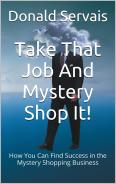
If you want beginner-friendly tips and honest guidance without hype, my book, "Take That Job And Mystery Shop It!" will give you the information you need to start. I'll also give you a list of over 150 mystery shopping companies to contact.
The mystery shopping business is always looking for new faces to visit different places.
Buy the Kindle eBook (instant download)
Buy the Paperback (best field manual)
Buy the Hardcover (durable reference copy)